

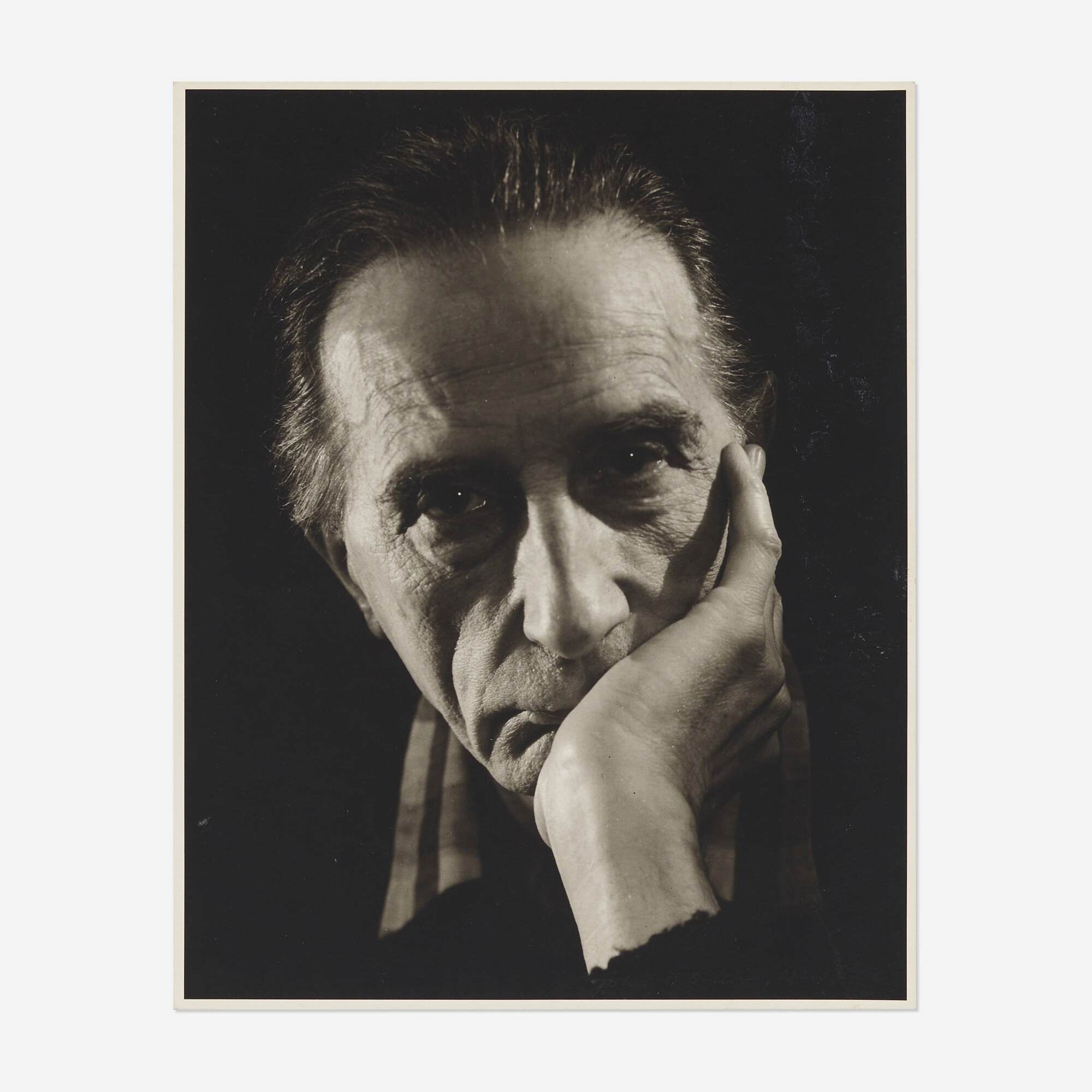
Marcel Duchamp (1887–1968) was a French-born American artist whose experiments with painting, objects and language transformed modern art. A central figure in the international avant-garde, he challenged established ideas of authorship, originality and artistic value.
Visual Language and Media
Duchamp’s readymades brought manufactured objects into the field of art through selection, naming and presentation. Works such as Bicycle Wheel and Fountain shifted attention from manual craftsmanship towards the artist’s decisions, helping open the way for conceptual art. Wordplay and unexpected relationships between objects and titles were central to his practice.
Education and Training
He moved to Paris in 1904 and briefly attended the Académie Julian. Much of his artistic development took place through independent study and exchanges with artists, including his siblings Jacques Villon, Raymond Duchamp-Villon and Suzanne Duchamp.
Artistic Practice and Projects
His painting Nude Descending a Staircase (No. 2) attracted widespread attention at New York’s 1913 Armory Show. Moving between France and the United States, he developed readymades, optical experiments and projects that crossed conventional artistic categories.
Alongside his own work, Duchamp helped establish the Société Anonyme with Katherine Dreier and Man Ray in 1920, supporting exhibitions and a collection dedicated to modern art.
Works at HICHAA
This profile forms part of HICHAA’s editorial exploration of avant-garde art. It does not indicate that works by Marcel Duchamp are available through the gallery. To discuss modern and contemporary art, contact HICHAA.
Further References
Marcel Duchamp at MoMA
Biography at Centre Pompidou
The Metropolitan Museum of Art: Modern Art Index